
Disclosure: Some links on Worth It Scout may be affiliate links. If you make a purchase through one of them, Worth It Scout may earn a commission at no additional cost to you. My opinions are based on my own experience with this pond project.
The Short Answer
Yes — for my pond, the 36W UV clarifier was worth buying because my main problem was suspended green-water algae.
It was not a replacement for the filter. That distinction matters.
I already had water moving through mechanical and biological filtration. I could trap debris and keep the pond circulating, but the water still carried the green cast that made it difficult to see the fish.
The UV clarifier addressed a different problem.
Once I added the inline UV and controlled the flow through it, the pond went from visibly green and cloudy to substantially clearer water with the fish showing through again.
That before-and-after result is why I would buy the UV again.
What a UV Clarifier Actually Does
A pond UV clarifier is installed in the water line so water passes through a housing around an ultraviolet lamp.
It is not designed to scoop leaves, trap fish waste or replace biological media.
Its job is different: expose suspended organisms in the water column to UV light.
That is why a UV is most useful when the water itself has turned green.
If your pond is brown because dirt is suspended in the water, or cloudy because a filter is dumping debris back into the pond, a UV may not solve the real problem.
In my system I still needed:
- Mechanical foam to catch physical debris
- Biological media to support beneficial bacteria
- A pump to keep water moving
- A waterfall return for circulation
- The UV specifically for the green-water problem
The product only made sense because I used it for the problem it was built to address.
Why I Chose a 36-Watt Unit
My pond is roughly 1,200 gallons.
The Half Off Ponds Shock Wave 36W unit I used is larger than my pond strictly by gallon rating, but the published operating range fit the pump and plumbing I was already using.
Manufacturer specifications list the 36W model for ponds up to 4,000 gallons with an optimal flow range of approximately 1,200 to 2,400 GPH.
My pump is rated at 1,800 GPH, which put the pump and UV in a sensible range together on paper.
The manufacturer also lists graduated hose-barb fittings from 3/4 inch to 1-1/2 inches, a 36-watt bulb, a quartz sleeve and a bulb-life rating of 9,000 hours.
Those are manufacturer specifications, not measurements I independently tested.
For my decision, the important figure was the flow range.
A UV clarifier can be the right wattage and still perform poorly if the water is pushed through the housing in a way that does not match the product’s intended flow range.
Why I Did Not Force All of the Pump Flow Through the UV
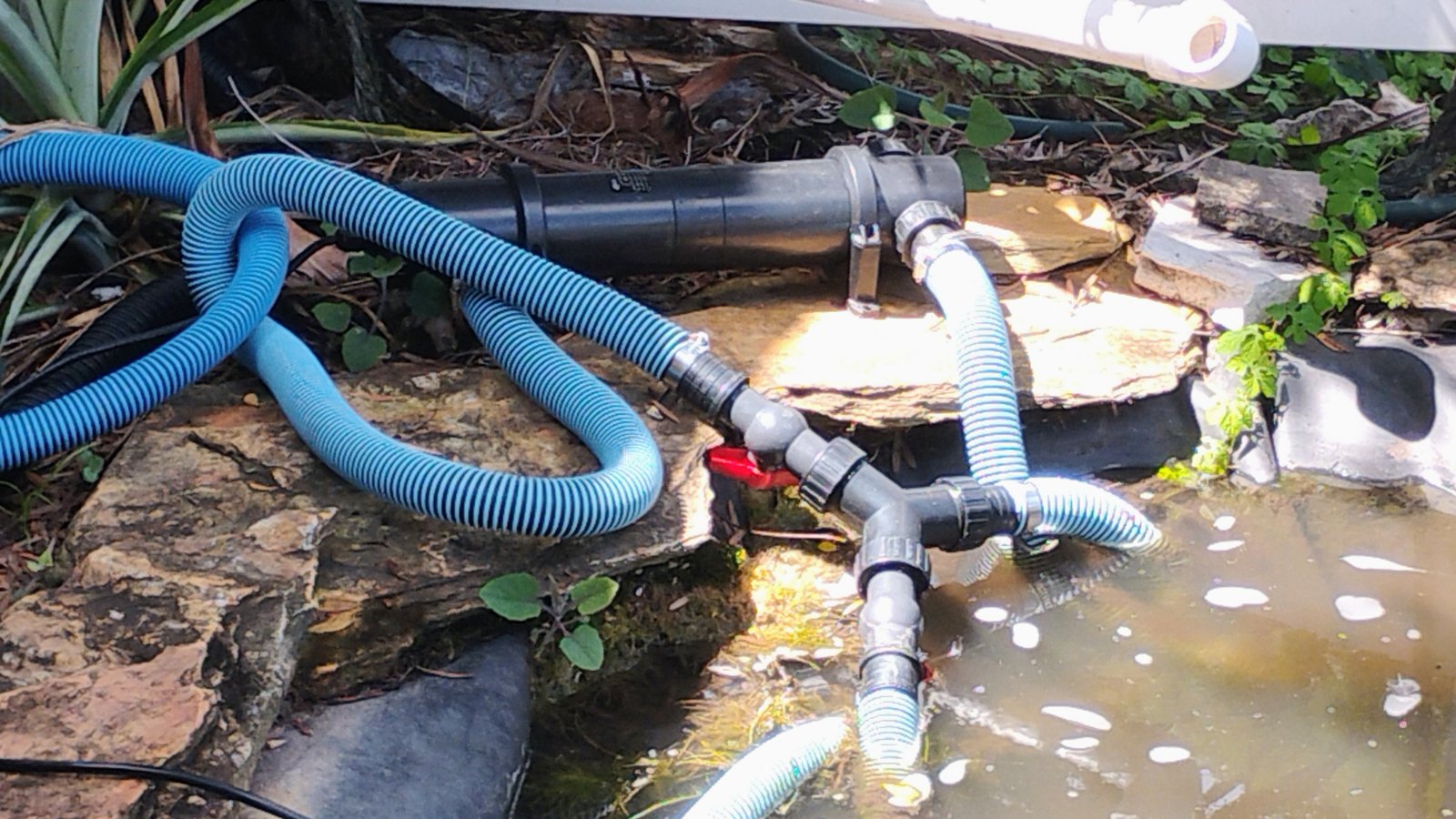
I added a 3-way bypass, and that turned out to be one of the best decisions in the plumbing layout.
A straight-line system makes every component dependent on the same flow path. If one filter plugs, a fitting restricts flow or you want to slow the water through the UV, you have fewer options.
With a bypass I could divide the flow.
That let me keep good circulation through the pond and waterfall while controlling the branch running through the UV.
The bypass also makes future maintenance easier because the system is less locked into one path.
I would rather spend money on a few valves and fittings than oversize a pump just because the plumbing gives me no control.
How Fast Did It Work?
I would not sell a UV clarifier by promising an exact number of days.
Pond clarity depends on how green the water is, actual flow, lamp condition, pond size, sunlight, filtration, fish load and how much new algae is being produced.
What I can say from my own project is that the improvement became visually obvious.
The useful evidence is the photo sequence. The earlier photos show a strong green cast and poor visibility. The later photo shows a dramatically clearer pond with fish visible below the surface.
That change happened after the filtration system had been reorganized around mechanical media, biological media, better flow control and the inline UV.
So I do not credit one product with everything.
But the UV was the component specifically added to address green water, and I would include it again if I were rebuilding the system.
When a UV Clarifier Is Probably Worth Buying
I would seriously consider one when:
- The pond water is green even though solids are being filtered
- The pump and mechanical filter are already functioning
- You can install the unit inline without creating a major plumbing mess
- The manufacturer’s flow recommendation is compatible with your actual system
- You are willing to maintain the lamp and quartz sleeve
A UV is especially attractive when you are tired of repeatedly treating green water with short-term fixes and want the clarification process built into the circulation loop.
When I Would Not Buy One First
- If the pump is undersized or failing
- If the pond is full of leaves, sludge or obvious suspended solids
- If the biological filter still needs attention
- If you’re assuming larger wattage will automatically fix an otherwise poor system
- Before checking hose sizes, head loss, available space and the electrical layout
The UV is a tool, not the entire pond system.
The Plumbing Mistake I Would Avoid
Do not build the entire system so tightly that removing the UV requires dismantling everything around it.
UV lamps and quartz sleeves are maintenance items. You want enough hose or unions around the unit to remove it without rebuilding the pond plumbing.
You also want the housing positioned where you can inspect for leaks and reach the indicator.
My system is visibly DIY, and that is fine with me. I would choose serviceability over hiding the UV behind landscaping where maintenance becomes a project.
What About Bulb Replacement?
The manufacturer rates the bulb at 9,000 hours.
That does not mean I would blindly run it until a clock says 9,000.
UV output can decline before a lamp visibly fails, and a glowing bulb does not necessarily tell you how much useful UV output remains.
For a seasonal backyard pond, I would follow the manufacturer’s replacement guidance, keep track of runtime and inspect the quartz sleeve when servicing the system.
If water clarity changes even though the rest of the pond is stable, the UV lamp and sleeve belong on the troubleshooting list.
My Real Pros and Cons
Pros
- It addressed the green-water problem my mechanical filter was not designed to solve
- The published flow range matched my 1,800-GPH pump well
- Inline installation let me use it with the rest of my DIY system
- The bypass gave me better control than a fixed single-line setup
- Replacement bulbs and parts are available for the model I chose
Cons
- It adds more hose, fittings, electrical equipment and potential leak points
- It still needs maintenance
- It will not compensate for a clogged pump intake or dirty mechanical filter
- The unit is only useful if water flows through it at a sensible rate
- It makes the pond plumbing look more complicated unless you hide or organize it well
What I Would Pair With It
For my pond, the UV works best as part of a simple system:
- OYO WATER 1,800 GPH pump
- 20-PPI mechanical filter foam
- DIY 5-gallon bucket filter
- Lava rock or other biological media
- 3-way bypass / flow-control fitting
- Waterfall return
That combination matters more than the UV wattage by itself.
If I were shopping from scratch, I would build the system around the water path first, then choose a UV whose flow range fits that path.
Worth It Scout Verdict
The 36W Shock Wave UV clarifier was worth it for my approximately 1,200-gallon pond because I had the exact problem a UV is good at addressing: green water.
I would not tell every pond owner to buy one.
But if your mechanical and biological filtration are working and your pond still looks like green soup, an appropriately sized UV clarifier can be a much more targeted purchase than simply adding another filter box or a larger pump.
My biggest recommendation is to install it with flow control. The UV itself matters, but being able to control how your system uses it matters almost as much.
Related Pond Guides
Worth It Scout note: product prices, availability and manufacturer specifications can change. Recheck the live listing before you buy.
Leave a Reply