
Disclosure: Some links on Worth It Scout may be affiliate links. If you make a purchase through one of them, Worth It Scout may earn a commission at no additional cost to you. My opinions are based on my own experience with this pond project.
The Short Answer
For my roughly 1,200-gallon backyard pond with a modest waterfall, a 1,800 GPH pump turned out to be a sensible size.
But I would not tell everyone with a 1,200-gallon pond to automatically buy a 1,800 GPH pump.
The rated flow number on the box is only the starting point.
Once you lift water uphill and run it through hose, fittings, filter media, a UV clarifier and a bypass, the actual flow reaching the waterfall can be considerably lower.
That is why the right pump depends on the entire water path, not just the pond volume.
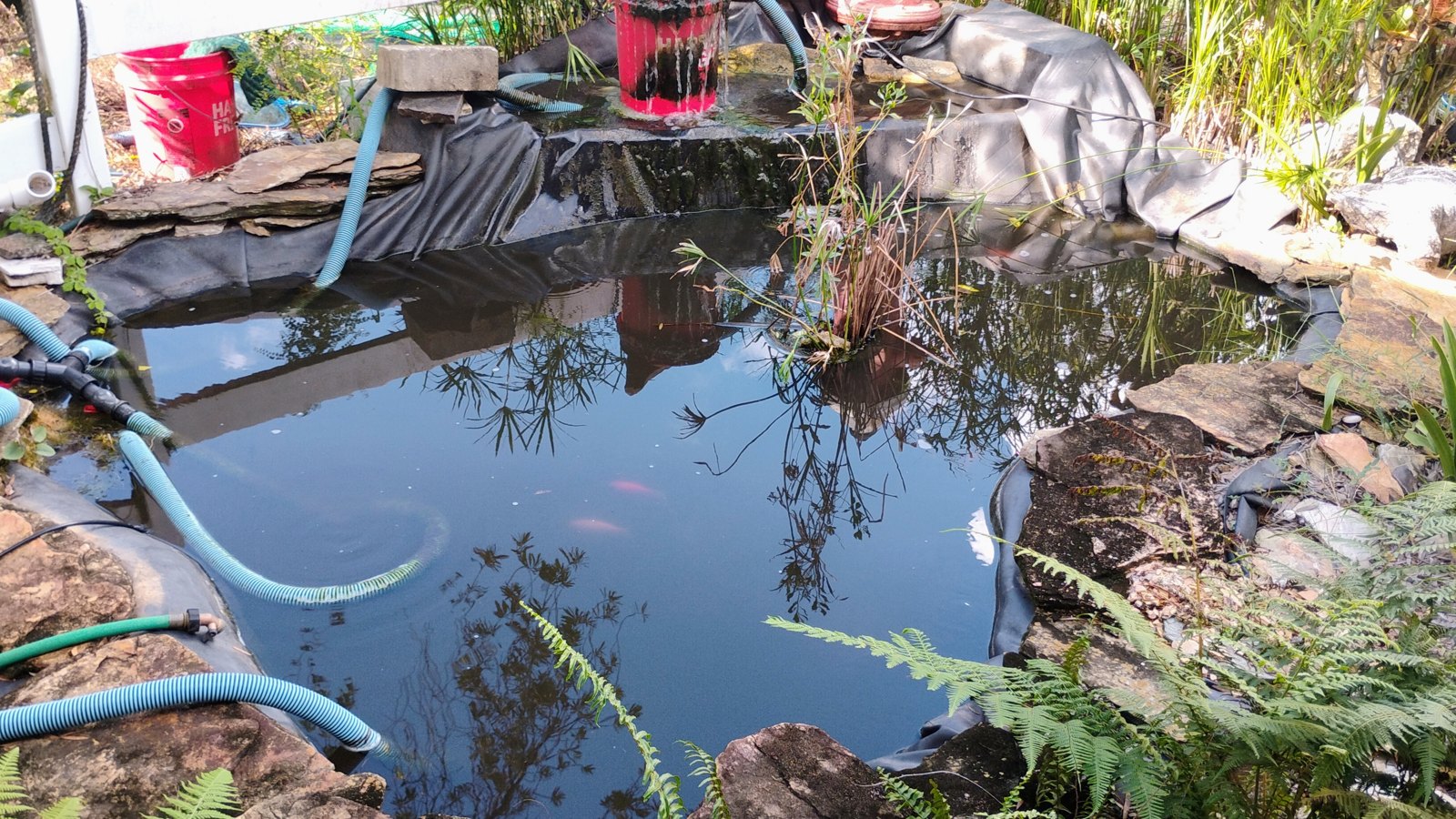
My Real Pond Setup
- Pond volume: About 1,200 gallons
- Pump: OYO WATER 1,800 GPH
- Waterfall: Raised return into the main pond
- UV clarifier: 36W inline unit
- Mechanical filtration: Cut-to-size filter foam
- Biological filtration: DIY bucket filter with lava rock
- Flow control: 3-way bypass
My goal was steady circulation, enough flow to make the waterfall look right, and a pump that could work with the UV and filtration without being wildly oversized.
Manufacturer specifications list the OYO WATER 1,800 GPH model with a 14-foot maximum lift and a 32.8-foot power cord.
Those are manufacturer ratings, not measurements I independently verified.
My own result is simpler: the pump provided enough circulation to keep the system moving and still feed the waterfall after the plumbing changes.
Why Pond Volume Alone Is Not Enough
A common shortcut is to pick a pump by saying the pond should turn over about once per hour.
That can be a useful starting point, but it is not the whole calculation.
A pump that produces 1,800 GPH at very low head may deliver much less after the water is lifted several feet and pushed through a real pond system.
The bigger your vertical rise, the more the flow can drop. Long hose runs, smaller-diameter hose, elbows, valves, dirty filter foam and inline equipment all add resistance.
So the question is not just, “How many gallons is my pond?”
It is also, “How hard does the pump have to work to move that water through my actual setup?”
Head Height Explained Without the Engineering Lecture
Head height is basically the resistance the pump has to overcome.
The most obvious part is vertical lift. If the pump is in the pond and the waterfall outlet is several feet above the pond surface, the pump has to lift the water that distance.
Then the plumbing adds more resistance.
Long hose, narrow fittings, elbows, valves, UV housings and clogged filter media can all reduce flow.
That means a 1,800 GPH label does not necessarily mean 1,800 gallons per hour will come out of the waterfall.
The pump curve matters. A pump curve shows how much flow the pump can produce at different head heights.
If a manufacturer publishes one, I would look at it before buying.
Why I Did Not Jump to a Much Larger Pump
It is easy to try to solve every pond-flow problem by buying a bigger pump.
That can create new problems.
- Push water through a UV faster than its recommended operating range
- Overflow a small filter chamber
- Make a modest waterfall look too aggressive
- Increase electrical use
- Pull plants and debris harder toward the intake
- Require larger hose and fittings to make use of the additional capacity
- Turn a simple system into an oversized system that has to be constantly throttled back
I wanted enough pump, not the biggest pump.
For my project, the 1,800 GPH class gave me useful headroom without creating an entirely different plumbing problem.
Why the 36W UV Affected My Pump Choice
The UV clarified more than just the water. It also helped clarify the system design.
The Shock Wave 36W UV unit I used is listed by the manufacturer with an optimal flow range of approximately 1,200 to 2,400 GPH.
The OYO WATER pump is rated at 1,800 GPH, so the two components were a reasonable match on paper.
I still used a bypass because actual flow changes as the filter loads with debris and because I wanted control over how much water went through the UV.
Starting with components whose published operating ranges made sense together was much better than forcing mismatched equipment to cooperate.
What Size Would I Start With for a 1,000–1,500 Gallon Pond?
If the pond has a low-to-moderate waterfall and a fairly normal hose run, I would start my shopping in roughly the 1,500–2,500 GPH pump class.
That is not a universal recommendation. It is a shopping range I would investigate before adjusting for head height, fish load, waterfall width, filter restrictions and the manufacturer’s pump curve.
A tiny decorative spillway does not need the same flow as a wide sheet waterfall.
A pond with a short 1.5-inch hose run also does not behave like a pond using long runs of smaller hose.
The final decision should be based on your actual layout.
How Waterfall Width Changes the Answer
The waterfall itself can become one of the biggest reasons to increase pump capacity.
A narrow spillway needs much less water to look full than a wide waterfall lip.
If you want a strong sheet of water across a wide weir, the pump may need considerably more capacity than the pond volume alone suggests.
That is why two 1,200-gallon ponds can need very different pumps.
One may have a quiet trickle over a small rock. The other may be trying to create a dramatic 24-inch waterfall.
I would size the pump for the water feature I actually want to see.
The Intake Problem: More Flow Means More Suction
My pond also taught me that pump size changes what happens around the intake.
When I added hornwort, the circulation pulled plant material toward the pump.
That turned plant placement into a filtration issue. A more powerful pump would have made that effect stronger.
So if your pond has loose plants, leaves, fish or string algae near the intake, think about the pump bag or pre-filter before simply buying more GPH.
The OYO pump came with a mesh barrier bag. That helped with larger debris, but no pump bag eliminates maintenance.
You still need to check the intake and clean it before restricted flow starts affecting the rest of the system.
What I Like About the OYO WATER 1,800 GPH Pump
- The price-to-flow ratio is attractive
- The long cord is useful when the outlet is not right next to the pond
- The included pump bag gives some intake protection
- The pump can be used submerged or in certain external applications according to the manufacturer
- The housing and rotor are serviceable enough that routine cleaning is practical
- Most importantly, it was large enough for my real setup without forcing a major redesign
What I Do Not Know Yet
Long-term durability is the part of the review that takes time.
A pump can look excellent after a few weeks and still be a poor value if it fails early.
So I would not pretend my project proves multi-year reliability.
What I can evaluate today is fit for the job, flow, installation, serviceability and whether I would buy the same size again.
For those points, yes.
How I Would Size a Pond Pump Step by Step
- Estimate the pond volume.
- Decide the minimum circulation goal.
- Measure the vertical rise from the pond surface to the waterfall outlet.
- Estimate the hose length and note the hose diameter.
- List inline restrictions such as UV clarifiers, filter boxes, valves, elbows and fittings.
- Decide how much waterfall flow you actually want.
- Check the manufacturer’s pump curve if one is available.
- Add enough capacity to account for real-world restriction without doubling the system for no reason.
- Make sure the pump’s likely operating flow is compatible with the UV and filter.
- Build in a way to control the flow if possible.
Why a Bypass Can Be Better Than Chasing the Perfect Pump on Paper
Pond systems change.
Filters get dirty, plants grow, hoses get moved, fittings get replaced and water levels change.
A bypass or adjustable valve gives you flexibility when the real system does not behave exactly like the numbers suggested.
That is why I consider flow control part of pump sizing.
The pump does not have to be mathematically perfect if the system gives you reasonable adjustment.
Worth It Scout Verdict
For my 1,200-gallon pond with a modest waterfall, the OYO WATER 1,800 GPH pump was a good fit.
I would buy the same size again for this specific setup.
The bigger lesson is that pond owners should not shop by pond gallons alone.
Use the pond volume to get into the right neighborhood. Then size for head height, waterfall demand, hose, filtration and the actual equipment in the loop.
An appropriately sized pump that works well with the rest of the system is more valuable than simply buying the biggest GPH number you can afford.
Related Pond Guides
- How I Cleared a 1,200-Gallon Green Pond: DIY Filter + 36W UV Results
- Is a 36W UV Clarifier Worth It for a Backyard Pond? My Real Results
- How to Build a 5-Gallon Bucket Pond Filter: My Simple DIY Setup
- 20-PPI Pond Filter Foam: What It Catches and How I Use It
Worth It Scout note: product prices, availability and manufacturer specifications can change. Recheck the live listing before you buy.
Leave a Reply